
On Scatological Bullying—Laughing all the Way To the Polling Station?
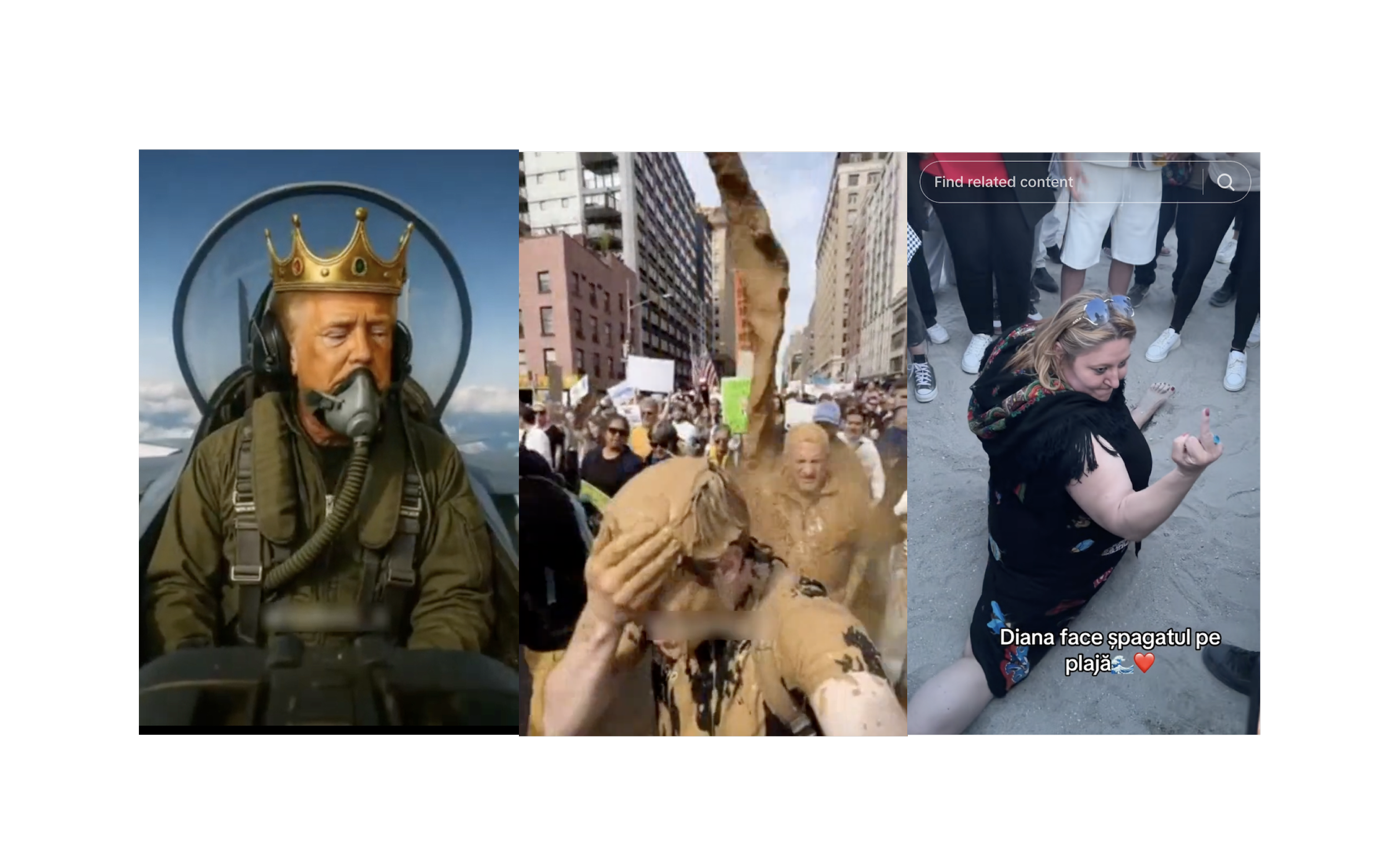
Scatological and sexual symbolic political communication on social media—collage
(Romanian and Spanish language versions are linked below)
In a recent social media post, U.S. President Donald Trump shared an AI-generated video of himself piloting a fighter jet, wearing a golden crown, and defecating on protesters carrying signs reading “No kings.” The absurdity and vulgarity of the image sparked both laughter and discomfort. For political commentators, it also evoked an older and more structured performance: the carnival.
In medieval Western Europe, beneath banners and bells, the social order was periodically suspended during carnival season. In these brief and highly codified events, the poor, the marginal, and the disenfranchised assumed symbolic power. Kings were mocked, clergy lampooned, the sacred profaned. Flatulence, bodily humor, and grotesque exaggerations were not mere comedy—they were political ritual inversions. Through them, the powerless reclaimed public space, however temporarily. But once the carnival ended, so did the illusion of reversal. The king returned. Hierarchy was restored.
Today, the grotesque is no longer confined to a codified performance, satire magazines like Charlie Hebdo, or subcultural spaces like memes. It has moved into the political mainstream. Scatological speech—once unpublishable—is now imbedded in political strategy. No longer leaked from private meetings or WhatsApp groups, it is delivered deliberately at rallies, posted on social media, and uttered in televised interviews. Political leaders—presidents, party leaders, or affiliated influencers—have incorporated vulgarity and bodily metaphors into their public discourse as instruments of domination.
This phenomenon cannot be reduced to impoliteness or even political incorrectness. It is something more precise and strategic: the rise of scatological and obscene rhetoric as a deliberate tactic of political bullying. Alongside rhetoric of sexual or physical violence, it is part of a broader repertoire of symbolic political violence—the use of language, gesture, and imagery to degrade, dehumanize, and intimidate.
Scatological language in politics doesn’t simply offend—it rallies or demobilizes. It functions rhetorically, symbolically, and socially. First, it shocks, pushing the boundaries of the sayable, marking the speaker as someone who “tells it like it is.” In an environment saturated with information, vulgarity cuts through the noise. For undecided voters, it triggers a blend of curiosity and disgust—a powerful combination in an age of algorithmic engagement.
Second, it signals authenticity. Leaders who swear or speak crudely position themselves not as polished or rehearsed, but as “real.” Scatological rhetoric often accompanies other symbolic acts of “normalcy”: eating fast food, drinking beer, rejecting institutional protocol. These gestures reinforce the image of the politician as a member of the masses—part of the majority in the street, rather than the elite in office.
For loyal followers, this style is affirming as it mirrors their lifestyle and aspirations: “He speaks like us,” or more precisely, “He speaks how we wish we could, if we dared.” It becomes a shared rebellion against elites—journalists, NGOs, feminists, foreign bureaucrats—all cast as joyless, politically correct, and corrupt.
Third, scatological speech humiliates and dehumanizes opponents. Calling a journalist “sewage,” describing migrants as “human garbage,” referring to critics as “excrement” strips them of moral worth. Disgust—one of the most primal emotional responses—is mobilized to frame certain groups as polluting or parasitic. Often, such language is followed by appeals to “clean up,” “purge,” or “sanitize”—thinly veiled metaphors for exclusion or violence.
Finally, it performs masculine strength. Swearing, especially in public and especially using bodily terms, is deeply coded as a sign of virility and dominance. Numerous studies have shown that men are more likely to use profanity to assert power or group identity. In this register, political language becomes territorial—a marking of symbolic ground. The nation is the body, and only some are worthy of inhabiting it. The grotesque has become a lingua franca of the populist, anti-system, and authoritarian right alike.
In the United States, Donald Trump referred to Haiti and other nations as “shithole countries” and pledged to “drain the swamp,” referring to cleaning the U.S. Capital of interest groups. Far from accidental, these expressions were strategic—signaling authenticity, dominance, and disdain. In the Philippines, Rodrigo Duterte used scatologic insults as a personal brand, including against the Catholic Church and the EU, and publicly joked about rape. His presidency was, in many ways, a continuous performance of scatological masculinity.
Elsewhere, the pattern repeats. For instance, in Hungary, Viktor Orbán described immigrants as “filth,” while former president of Brazil, Jair Bolsonaro spoke about LGBTQ+ activists in similar terms. In Romania, populist social media accounts regularly depict pro-European politicians as “trash,” and even a female MEP threatened symbolic urination on critics who body-shamed her. These are not outbursts, they are political tactics—calculated performances of symbolic dominance. Crudeness has become a form of political power.
Scatological rhetoric operates within a broader repertoire of symbolic violence. Like threats of rape, lynching, or public humiliation, it is not (initially) physical—but it lays the groundwork for physical aggression. It redraws the moral map, distinguishing between humans and waste. The escalatory mechanism often follows a predictable path. First, dehumanization—as opponents are framed as waste, filth, or vermin. Then, repetition across media platforms dulls the shock and embeds the insult leading to normalization. To their supporters, the leader’s language acts as a permission signal and is interpreted as moral license to harm. And finally, followers act on the rhetoric, whether through harassment or violence.
There is a growing body of evidence linking grotesque, vulgar rhetoric to real-world violence. Perhaps the most known is the January 6, 2021, attack on the U.S. Capitol, following Trump’s language—including references to “human scum” and the need to “drain the swamp”—helped frame violence as cleansing, not criminal. But event before that, in 2008 both the Democratic and Republican parties accused each other of planning to use weapons connected to human waste. Moreover, the Israeli Defense Forces have used feces-contaminated water against Palestinian protesters. Additionally, the Drug War in the Philippines led to extrajudicial killings of over 12,000 individuals, after president Duterte said that he didn’t give “a shit about human rights”.
In India, when the 2020 riots left 53 people dead, escalation was attributed to political leaders calling their opponents scatologic names. Similarly, in Italy, Brazil, or Turkey, ttacks on migrants, LGBTQ+ activists, and civil society groups followed grotesque dehumanization. In Moldova, bag of feces was thrown at a local branchof the Socialist Party and the building was smeared in excrement, in the context of increasingly divisive rhetoric. While mass violence has not occurred in Romania, some sovereigntist MPs threatened and pushed their colleagues in the parliament, and journalists and women politicians have reported doxxing, threats, and home surveillance after targeted smear campaigns.
Humor still plays a role in political communication—even cloaking vulgarity as “just a joke.” But in today’s increasingly polarized politics, sometimes it is not people’s satire aimed at power. It is power punishing dissent with symbolic violence. We have crossed a threshold. The grotesque no longer mocks the throne. It occupies it. The carnival is no longer a hiatus from order. It is the order. And its organizers, to paraphrase a well-known lyric, are laughing all the way to the polling station. The joke’s on us, then?
This article was originally published in Romanian, on Republica.ro: Despre mişto-ul scatologic: o ținem tot într-un râs până la urne?
Republished in Spanish, on Beers and Politics: Acoso escatológico: ¿Riendo todo el camino hasta el colegio electoral?