
Resources
At Perseveras, we believe that knowledge evolves through continuous learning, dialogue, experimentation, and collaboration. This page features analysis, tools, and insights on emerging issues in political and international affairs, public governance, and human rights. It amplifies expert voices from diverse backgrounds—thinkers, practitioners, and reformers whose work deepens our understanding of democratic governance and civic resilience. It serves as a hub for learning, reflection, and practice—where multiple perspectives come together to inspire action and sharpen strategy.
Here you’ll find approaches that challenge assumptions and distill complex political realities into actionable insight; manuals that guide practitioners through the nuances of implementation; and toolkits that translate evidence and experience into hands-on methods for monitoring, reform, and transformation. We welcome your feedback and resource submissions at info@perseveras.com.
Report
The Architecture of Risk.
Assessing the Personal, Professional-Political, and Contextual Dimensions of Violence Against Women in Romanian Politics
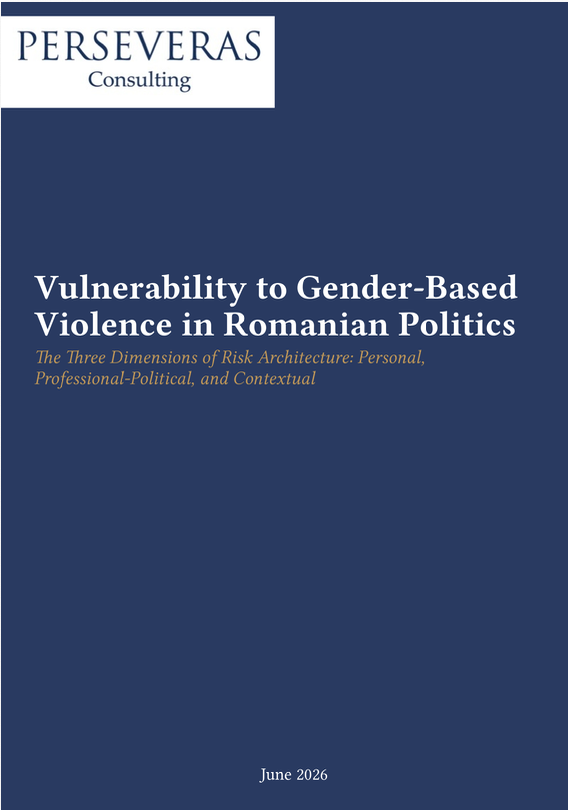
A new pilot study commissioned by the Association for Evolution and Responsibility (AER), as part of its work to strengthen the resilience of women in public and political life in Romania, examines this risk through the Perseveras VAWP Vulnerability 360° framework. The study analyzes 20 profiles of women politicians in Romania between March 2024 and March 2026, using open sources. Its purpose is not to rank women by risk, but to identify recurring patterns of exposure, vulnerability, and political instrumentalization.
The study assesses vulnerability across three interconnected dimensions: personal, professional-political, and contextual.
The personal dimension shows how private life can become a battleground for political contestation. Marital status, motherhood, the absence of children, family life, values, communication style, or appearance can be used to question a woman’s legitimacy as a political actor. Personal life is transformed into material for ridicule, moral judgment, or delegitimization. The professional-political dimension shows that competence does not automatically reduce risk. Education, international experience, technical expertise, senior positions, and strong networks may strengthen authority, but they can also be reframed as elitism, dependence on external interests, distance from voters, or lack of “authenticity.” In polarized settings, competence can become both a source of power and a target of attack. The contextual dimension highlights the political environment in which these risks unfold. It looks at the wider conditions that shape exposure: gender norms, public polarization, institutional responses, impunity, anti-gender movements, geopolitical narratives, and the broader quality of political competition.
A context that amplifies vulnerability
The Romanian context analyzed in the study was shaped by overlapping pressures: political polarization, strained trust in institutions, economic frustration, and the legitimacy crisis triggered by the cancellation of the first round of the 2024 presidential election. These conditions created fertile ground for anti-elite and anti-system narratives. Geopolitical positioning also became part of domestic political conflict. Women associated with institutions, reformist politics, the pro-European agenda, or “the system” could be targeted not only through ordinary political criticism, but through attacks combining misogyny with anti-Western, anti-institutional, or sovereignist messages. Anti-gender narratives further amplified these risks by framing women’s autonomy, authority, and public presence as suspicious or threatening. In this environment, attacks against women politicians became part of broader struggles over identity, legitimacy, national direction, and democratic trust. The study also shows that political parties are not always protective spaces. They may offer visibility and advancement, but can also reproduce misogyny, marginalization, selective protection, and reputational pressure. Promoting women to visible roles is insufficient if internal cultures punish those who challenge informal rules or denounce misogyny.
What the case studies suggest
The report includes three case studies that point to deeper dynamics requiring further attention. The first concerns the continuum between digital and real-world violence. Online harassment, sexualized narratives, fabricated content, reputational attacks, and physical aggression should not always be treated as isolated incidents. Digital abuse can create a persistent archive of denigration, normalize hostility, and contribute to a climate in which later forms of pressure or violence become easier to justify, trivialize, or ignore. This does not prove automatic causality between online and offline violence, but it does show why early warning and early response matter.
The second concerns the need to move beyond a simple binary of woman-victim and male-aggressor. Some political profiles show that victimization, authority, and accountability can coexist. Women politicians may be targets of misogyny, domestic pressure, digital abuse, or reputational attacks; they may also exercise power forcefully, aggressively, or in ways that affect others. Recognizing this complexity does not relativize violence against women in politics. On the contrary, it allows for a more rigorous discussion of how gender, power, vulnerability, and responsibility interact in real political environments.
The third concerns internal party misogyny. One case illustrates what can happen when a woman politician names misogyny inside her own party. Instead of the organization treating misogyny as a structural problem, the response may shift toward disciplining, discrediting, or isolating the woman who raised the issue. This sends a broader message to other women: advancement may be possible, but challenging the system's informal rules can exact high political costs.
Why it matters
Gender-based violence in politics affects more than individual women. It shapes who participates, who remains visible, who self-censors, and who withdraws or never enters politics at all. When public visibility brings sexualization, harassment, reputational attacks, domestic exposure, institutional pressure, or ridicule, the cost of participation rises. The Perseveras VAWP Vulnerability 360° framework helps identify these risks earlier. Its value lies not in labeling individuals, but in helping parties, institutions, civil society, and support actors understand how vulnerability is produced—and where prevention, protection, and accountability need to improve.
Analysis
Do We Reap What We Sow? The Normalization of Political Violence in the 21st Century
Political violence is increasingly embedded in both democratic and transitional politics. Fueled by underperformance, identity manipulation, digital radicalization, criminal–political nexuses, and foreign interference, violence is becoming normalized—producing fear, disengagement, and a gradual erosion of the public sphere.
If we are indeed reaping what we have sown, the remedy lies not in despair but in deliberate re-cultivation. Preventing political violence requires more than security measures; it demands a cultural reset. Political discourse must reintroduce empathy as a civic virtue, transparency as a moral standard, and restraint as a form of strength.
Democratic resilience is built not only in parliaments and polling stations but also in classrooms, newsrooms, in public squares, and online spaces—where citizens learn, consciously or not, how to treat dissent and difference. Strengthening civic education, supporting ethical journalism, and promoting trauma-informed leadership are practical steps toward rebuilding trust.
Ultimately, political violence is not an accident of history but a mirror of collective choices. We can continue to sow fear, outrage, and exclusion—or we can plant the seeds of a more humane political culture. The harvest will depend on what we choose to cultivate today.
Analysis
Trauma and Public Policy. Towards Empathetic Governance in Romania
Romania’s reform cycles, from post-1990 privatizations to today’s austerity, reveal a deeper social fatigue. Repeated, externally driven adjustments have eroded trust, dignity, and civic engagement.
This article argues that sustainable reform requires empathetic governance—linking efficiency with meaning, legitimacy, and public value—to rebuild confidence between citizens and the state and ultimately prevent social unrest, democratic disengagement, and the rise of populist extremism.
Leaders who embrace purpose-driven governance recognize that people experience reform as more than a budget line entry. They name the losses, acknowledge the grief, and connect sacrifice to a greater collective good. They protect dignity even as they manage difficult trade-offs. This approach strengthens legitimacy, sustains capacity, and makes the creation of public value credible.
For Romania, empathy is not cosmetic. It is a condition for legitimacy, a cornerstone of resilience, and the foundation for rebuilding public trust. Governments that respond with empathy and lead with purpose can transform painful change into renewed trust. Those that fail to do so risk entrenching resentment, undermining legitimacy, and weakening the very capacity they need to govern.