
Why We Can No Longer Afford to Hide in History’s Cellar: If You’re Not at the Table, You’re on the Menu
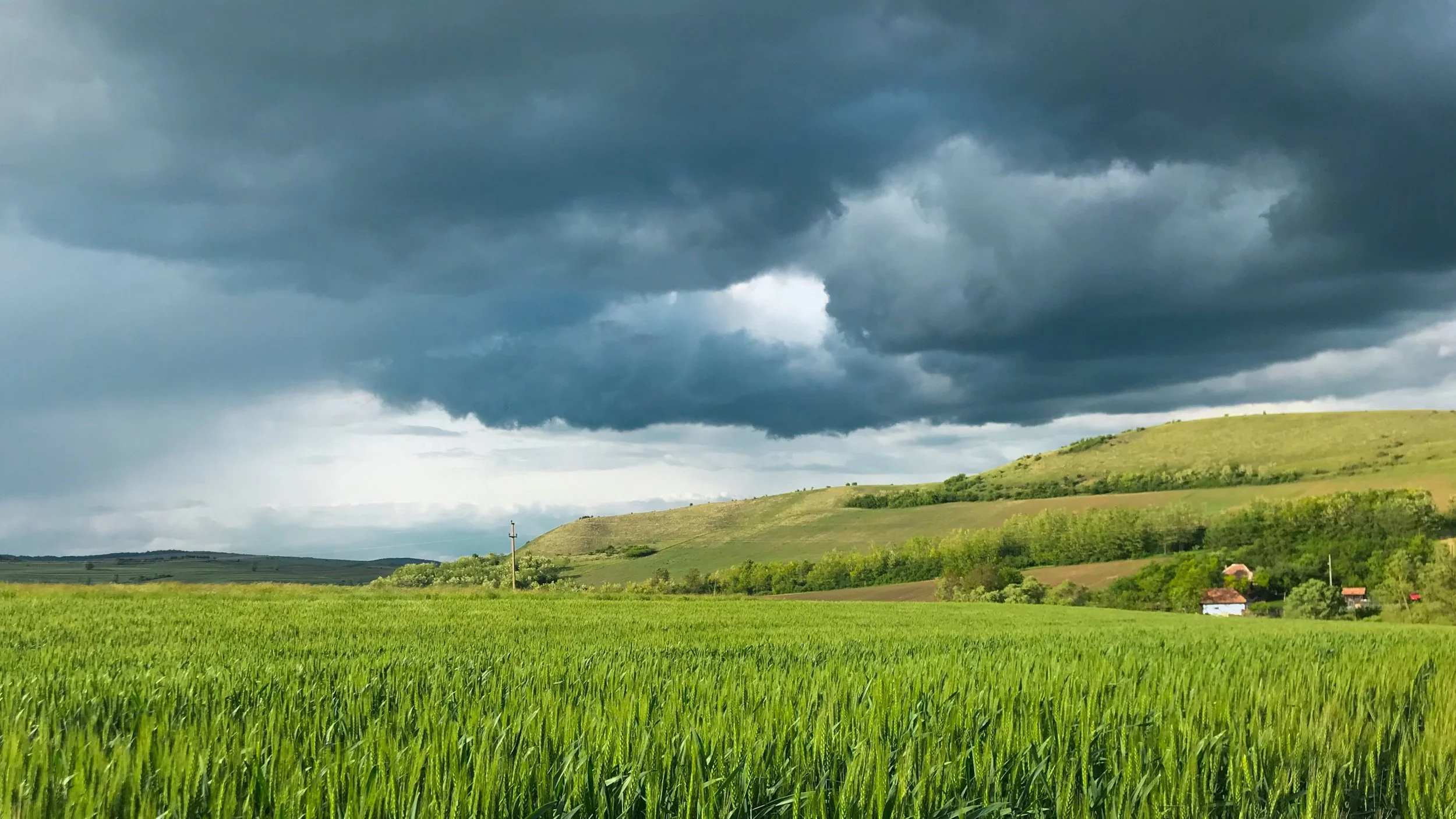
Village in Transylvania, Romania
(Romanian language version linked below)
We were huddled together, the lights off, trying to guess how far away the gunfire was. The shots sounded muffled. Then, all of a sudden, a rain of metal fell over the house. My father grabbed my sister and me by an arm each and hurled us into the cellar. We stayed there for a while, barefoot, wrapped in an old rug, in a basement that smelled of pickled cabbage, until no more shots or cars could be heard. My mother worked in a shop in town and had been ordered to stay at work to “defend the site,” together with a handful of colleagues, in case of an attack by protesters. The next day, December 22, only late in the day did the neighbors dare to come out to their gates. Our house hadn’t been badly damaged—just a few holes in the roof. We, children, played with the shrapnel until we cut our palms.
The weeks that followed smelled, to me, of hope and new beginnings. That’s how I felt when I opened the “box of goodies.” A truck from Germany had arrived in the village, and every family received a box: canned food and secondhand clothes of a quality better than anything we had ever owned, and they smelled incredibly good. It was the smell of a new beginning—inevitably a better one.
About the past, I had mixed feelings of hatred and shame. How could entire generations endure cold, hunger, and terror without doing anything? But I had one certainty: fear and despair would never return. And if they belonged to the past, what was the point of stirring them up? You put them in a jar with a lid, hide them in the cellar behind the barrel of pickled cabbage, and get on with your life. After all, survival during the transition—miners’ riots, ethnic conflicts, inflation, corruption—keeps you busy enough.
Globalization came with the promise that we were all finally starting on equal footing: opening borders and minds, relocating industries, frequenting respectable organizations. In reality, we remained a sleepwalking society, waking up only from time to time, in moments of crisis, to reaffirm the principles for which many had sacrificed themselves in 1989.
Looking back—and having observed multiple political transitions across different continents—successes are rare, incomplete, and reversible. That is precisely why each one must be protected: from within, but also from outside. Until recently, at least at the level of discourse and diplomatic gesture, liberal democracies—led by the United States—supported the universal values enshrined in the UN Charter. Today, analysts are struggling to find a name for the period we are living through. There is a quiet consensus that the era of post–Cold War relaxation and solidarity ended with President Trump’s second term.
The vocabulary and ideology of the new era are still being forged—in ministries, universities, think tanks, and conferences where experts are trying to make sense of and name what is happening. This was also the atmosphere of a recent regional conference on international development held in Canberra, Australia. Officials, practitioners, and academics tried to decipher the new world order.
A sense of inevitability dominated the discussions. A reactive rhetoric is taking shape as “middle powers” take stock of the political impact of tariff policies and other coercive measures adopted by the United States. Middle powers are not superpowers, but they wield significant global influence through diplomacy, multilateralism, and norm-setting rather than brute force. Countries such as Canada, Australia, South Korea, or Brazil have leveraged strong economies, advanced technologies, and diplomatic capital to support international cooperation—often acting as mediators between great powers.
The first major observation is a shift in framing: there is increasing talk of “shared principles,” and less of universal principles. A trend is emerging toward strategic withdrawal from the world and the protection of direct interests—a so-called policy of distancing and defending—as well as a tacit acceptance that external interference is becoming a fact of life in international relations, influencing domestic policies and electoral processes.
“We’re not turning our backs on the world,” one official said, “but we do need to make some adjustments.” Faced with this contemporary challenge, middle powers are turning toward pragmatic partnerships, justified by the idea that development cooperation remains the main currency of exchange. In a time of uncertainty, these powers are strengthening ties with one another; knowing what you can rely on becomes a value in itself.
Moreover, the double pressure—external, geopolitical, driven by U.S. and Chinese policies and the wars in Ukraine and Gaza, and internal: economic, migration-related, social fragmentation—forces these states, traditionally oriented toward multilateralism and solidarity, to retrench. The objectives of external cooperation are increasingly aligned with national economic interests.
Cooperation is no longer enough to produce social, economic, or cultural development in the partner country. It must demonstrate that it strengthens bilateral relations and delivers direct benefits. Economic and security interests are key indicators of how acceptable a project’s risk is. International relations thus enter a phase dominated by transactionalism, where trade becomes the primary axis of cooperation. Partnerships between actors with different values will be governed by the lowest common denominator.
In some cases, this approach may favor direct arrangements with the private sector, with states limiting themselves to facilitating relationships. In others, however, the link between trade and compromise becomes much tighter. In strategic sectors such as rare-earth extractive industries, infrastructure, technology, and arms, the state is often a central actor, both as investor and regulator.
Here lies the inflection point that middle powers must weigh carefully. Do you ignore that a partner government is corrupt or authoritarian if your companies are thriving and you can tax them? Do you make a pact with the devil to get through a difficult economic period? What are the long-term consequences?
Can the lack of good-governance standards, political repression, and corruption undermine the profitability of your companies and, implicitly, state revenues? Can the political environment deteriorate to the point that the country slides into social conflict or expels foreign firms? Do you risk being punished by your own electorate for this?
And finally, where do we stand—countries still developing, many former dictatorships or states marked by internal conflict—in this geopolitical tectonic reshuffling? For now, we are witnessing a coordination of messaging among middle powers: the rhetoric of inevitability, strategic withdrawal, and transactionalism. It is time for developing countries to make room at the negotiating table and stop waiting for a “solution in an envelope” from actors engaged in active interference.
Even today, we do not know exactly what happened that December night in 1989 in our village. But we know that when we came out of the cellar, the world outside was different.
As former dictatorships, now societies in transition, we cannot afford to remain in history’s cellar, paralyzed by a sense of inevitability. Because if we are not at the table, we are back on the menu.
This article was originally published in Romanian on Republica.ro: De ce nu ne mai permitem sa stam in pivnita istoriei: daca nu esti la masa, esti in meniu