
The prodigal son and nostalgia for empires: Rubio's speech in Munich
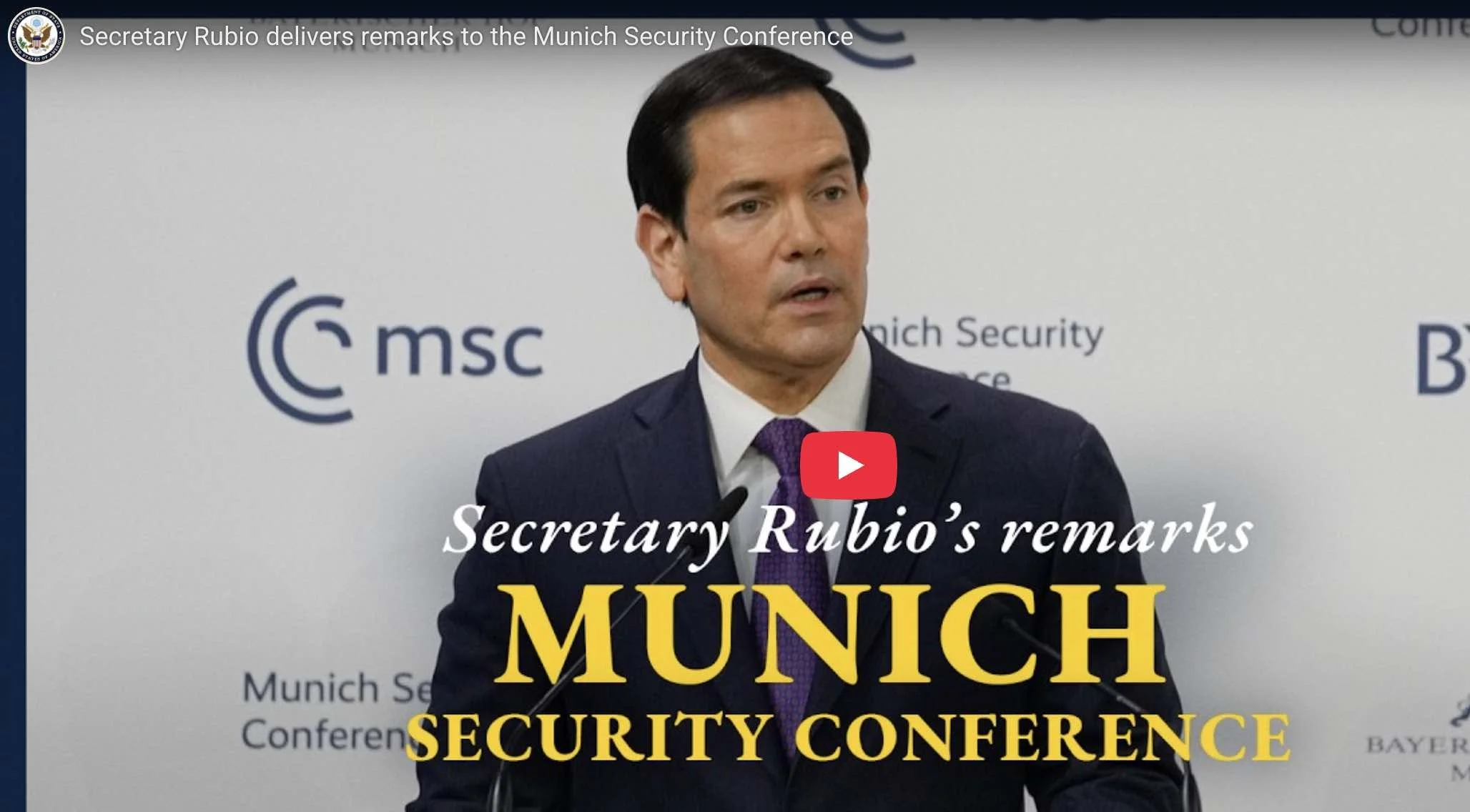
U.S. Secretary of State Marco Rubio, delivering his remarks at the 2026 Munich Security Conference
(Romanian language version linked below)
The speech by U.S. Secretary of State Marco Rubio at the Munich Security Conference was greeted by many with a wave of relief after last year's shock caused by Vice President JD Vance's combative tone. Rubio reiterated that Europe and the United States remain intrinsically linked by history, culture, and political values.
But at the same time, he clearly announced that the United States is changing its strategic direction, returning to a policy of power, and inviting Europe to follow suit. Otherwise, it risks irrelevance or even collapse. The message was twofold: emotional continuity, strategic discontinuity.
In an attempt to flatter Europe, Rubio spoke of it as a civilization thousands of years old, the cradle of great empires. In the 21st century, however, nostalgic evocation of bygone empires sounds strange. Not only because it glosses over the fact that territorial expansion meant the conquest and exploitation of peoples and resources on other continents, but also because it forgets that, in Europe, half the continent lived under the domination of several empires.
For Central and Eastern Europe, the empire is not a cultural metaphor, but a concrete historical experience. And what allowed these states to stabilize and consolidate themselves as actors in international law was precisely the much-loathed "rules-based order," which enshrined the principles of territorial inviolability and non-recognition of changes to borders by force.
The conflicts in the Balkans in the 1990s remain a warning about what can happen when territorial and identity claims are negotiated at gunpoint.
Rubio invoked, not without a certain interpretative freedom, Francis Fukuyama's book, The End of History and the Last Man, presenting it as a great illusion that promised globalization as a godsend. But this reading oversimplifies things. Criticism of globalization omits an uncomfortable detail: the deindustrialization of Europe was not imposed by Russia or China, but took place within a global economic system decisively shaped by international financial institutions strongly influenced by the United States, such as the IMF and the World Bank.
Moreover, the argument is not taken to its logical conclusion. If globalization and the figure of the "global citizen" did not represent the apotheosis of history, neither is the MAGA movement exactly the pinnacle of political evolution. And Trump is not "the last politician," not even in an unlikely scenario in which he tried to push the constitutional limits to secure a new term.
Rubio, born in the United States to Cuban immigrant parents, claims European ancestry and a civilizational connection to Europe. At the same time, Cuba is facing a profound socio-economic disaster caused by US sanctions and oil import blockades, which have led to a multi-sector crisis. While the rhetoric flatters Western pride by evoking a glorious past, the Cuban reality offers a preview of what small states can experience when the great powers fail to exercise self-control.
The danger for us Europeans is different: to allow ourselves to be seduced by flattery and to project, through comfortable mental gymnastics, a return to fantasies of sovereignist identity, whether imperial or indigenous. In the face of praise for the past, it is difficult to remain lucid and accept the hard, unglamorous work of contemporary political compromise: harmonizing increasingly divergent social interests and needs in a pluralistic democratic space.
Rubio said, "Although our home is in the Western Hemisphere, we will always remain the sons of Europe." The formula is elegant.
And to some extent, the United States is a product of European political tradition. But today, this son seems wasteful in relation to the values he has learned: pluralism, the balance of powers, the rule of law, respect for treaties and alliances.
Europe must react neither with resentment nor naivety. History did not end in 1945, nor in 1989, and it will not end in 2026. The international order is not a given, but a permanent process of negotiation and reconstruction.
And when the prodigal son returns, he will be welcomed. For pride is often the prerogative of youth, and moderation the sign of historical maturity.
This article was originally published in Romanian on Republica.ro: Fiul risipitor si nostalgia imperiilor. Discursul lui Marco Rubio la Munich